Define process
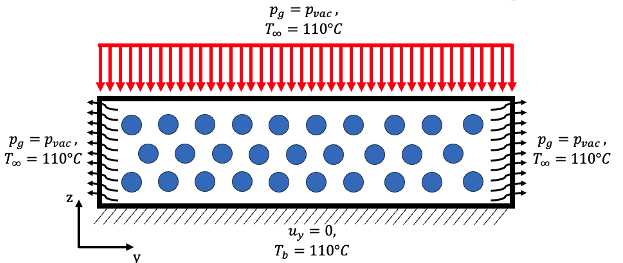
Set pressure, temperature, vacuum, laminate geometry, material laws, and boundary conditions.
Software framework
ComPACT connects compaction pressure, laminate architecture, resin transport, thermal history, cure behavior, and defect evolution in one simulation-focused workflow for composite manufacturing.
Set pressure, temperature, vacuum, laminate geometry, material laws, and boundary conditions.
Use macro VUEL models for part behavior or micro MRT-LBM-DEM models for local flow mechanisms.
Read thickness change, porosity, resin bleed, void motion, cure state, deformation, and defect geometry.
Compare outputs with microscopy, flow visualization, residual-shape testing, and benchmark data.
Solver architecture
The page separates the part-scale macro solver from the local micro solver so each case can show the right physics at the right length scale.
Hex8 Abaqus/Explicit user element for thermo-chemo-poro-mechanical composite-process modeling at laminate and part scale.
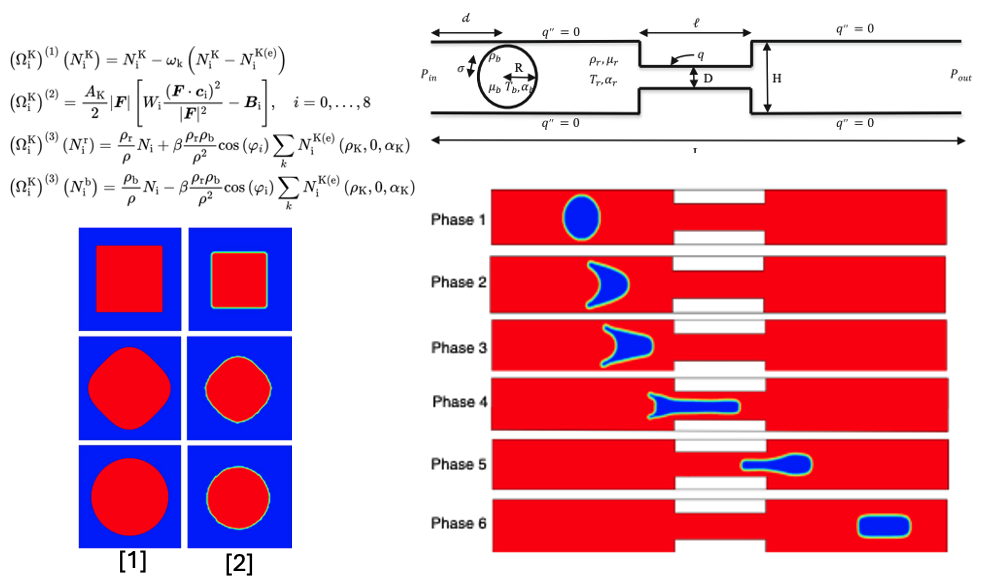
MRT-LBM-DEM solver for local resin flow, particle motion, trapped air, immersed moving boundaries, and benchmark validation.
Capabilities
These modules frame the page around the problems ComPACT is built to explain: compaction, resin transport, defects, cure, validation, and solver coupling.
Track thickness change, ply nesting, pressure transfer, and laminate consolidation.
Connect local deformation, resin transport, void evolution, and process history.
Model resin, voids, trapped air, and interface motion during pressure-driven processing.
Prepare coupled simulation paths for mechanics, flow, temperature, and cure effects.
Organize model outputs for comparison with microscopy, DIC, micro-CT, and tests.
Use the micro_ComPact MRT-LBM-DEM solver for coupled resin flow, particle motion, and compaction boundary conditions.
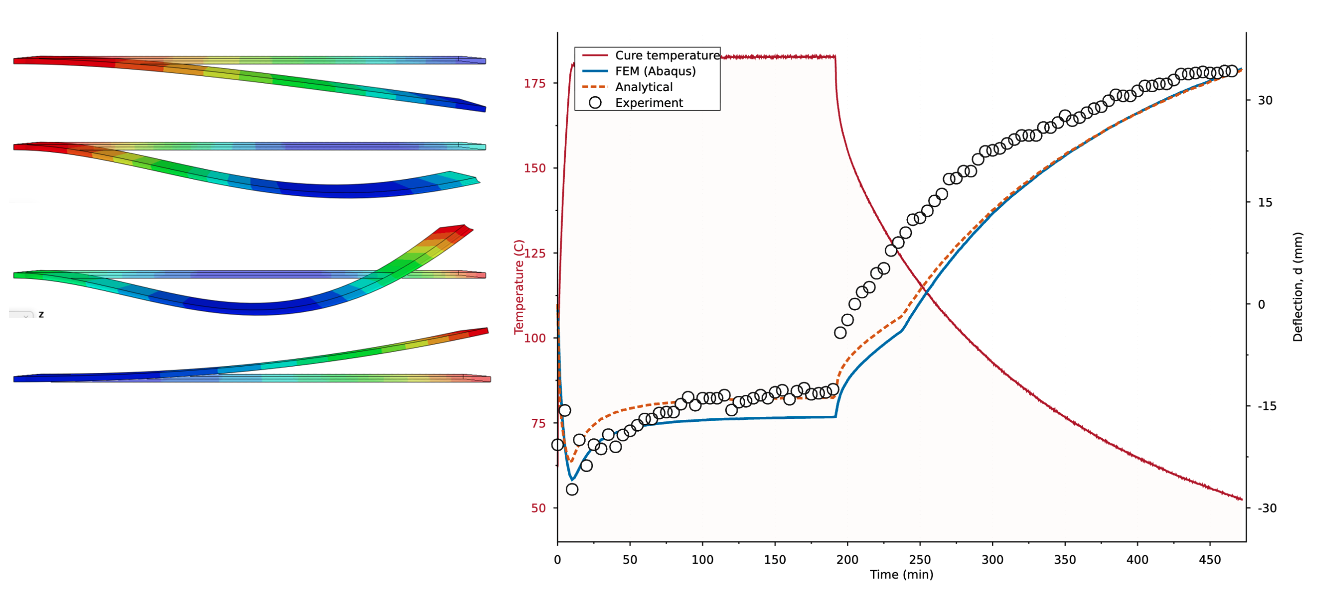
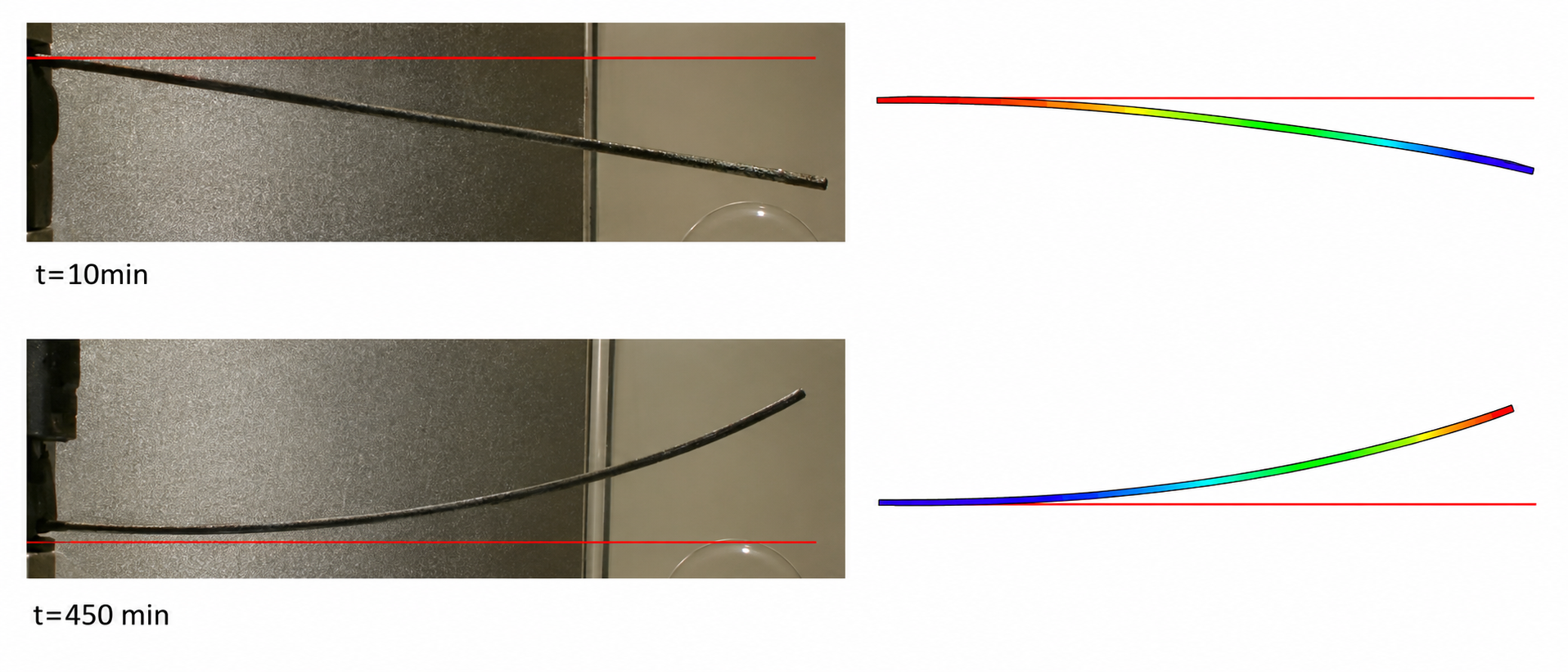
Compare modeled and measured spring-in, curvature, and deflection after thermal processing.
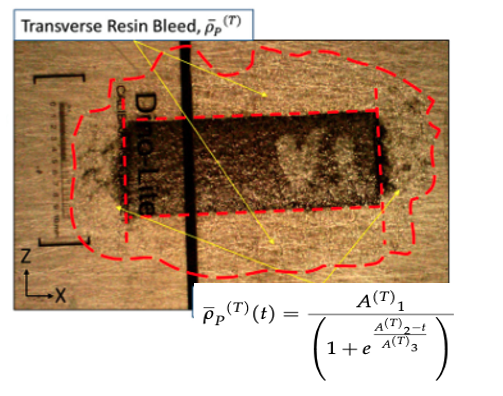
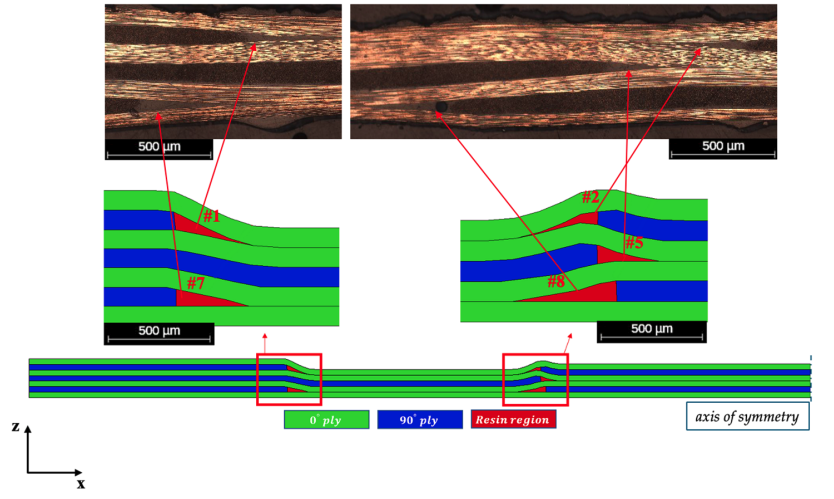
Translate microscopy observations into simulation-ready ply paths, resin pockets, and local defect geometry.
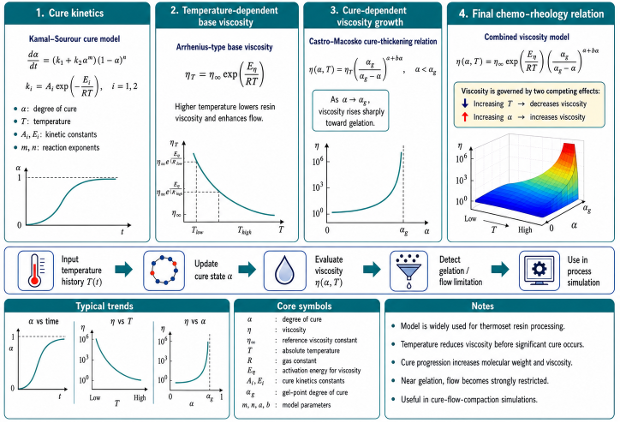
Connect cure kinetics, temperature, viscosity growth, and gelation into process-scale front simulations.
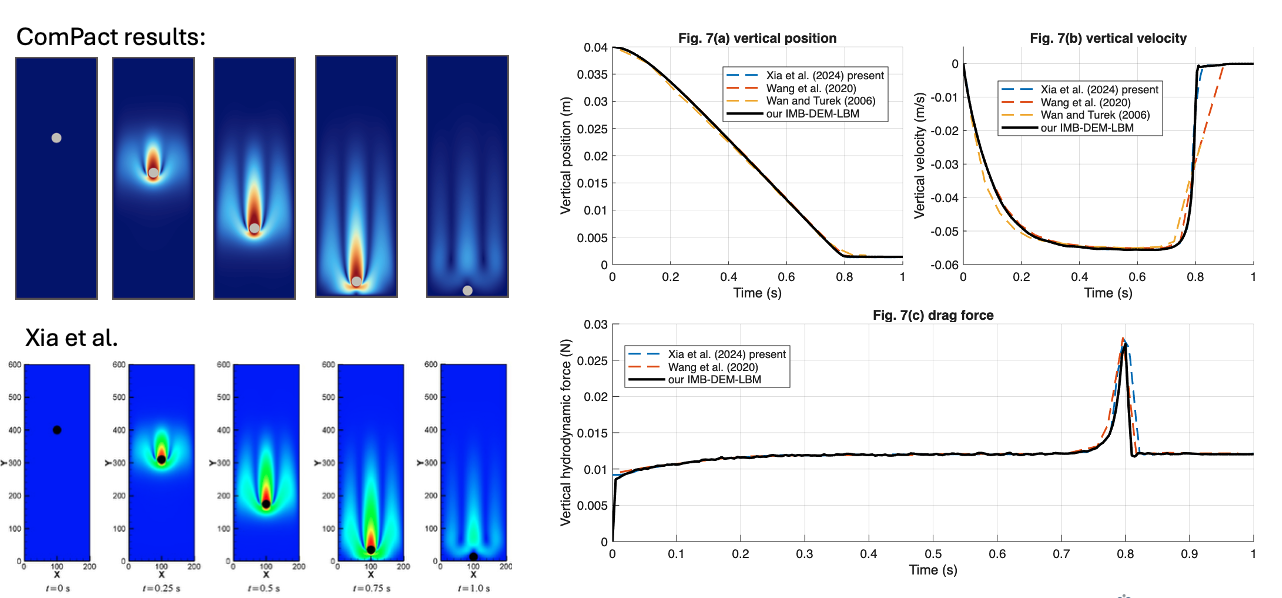
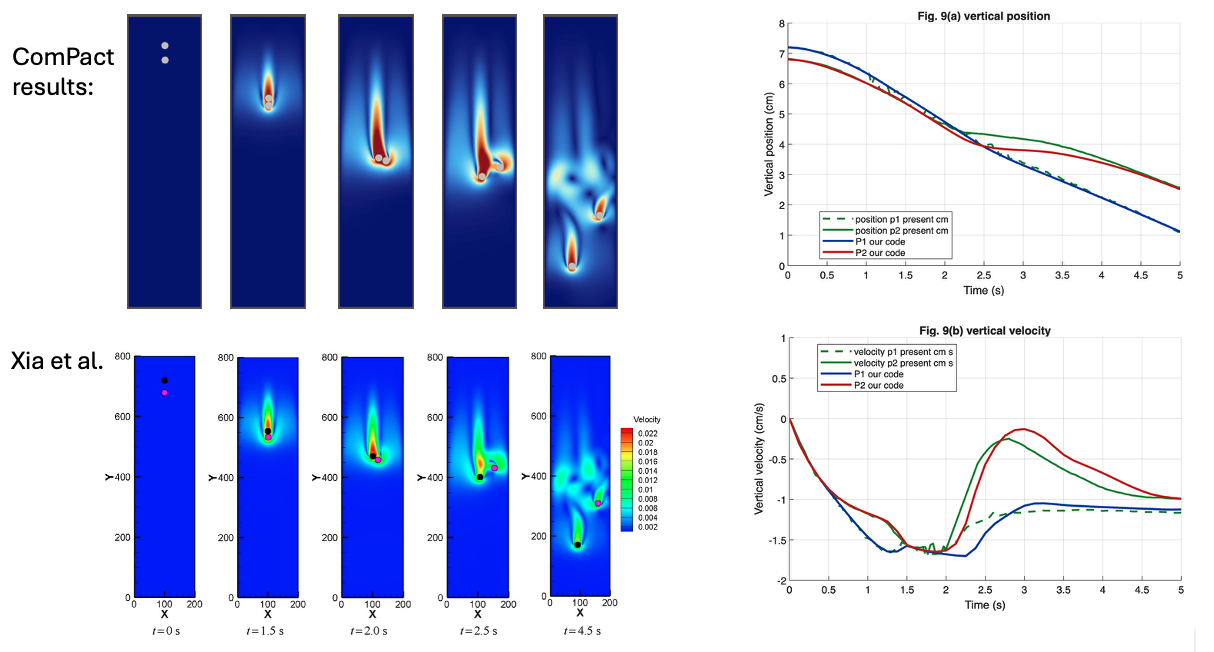
Compare particle-fluid simulations against published sedimentation and interaction benchmarks.
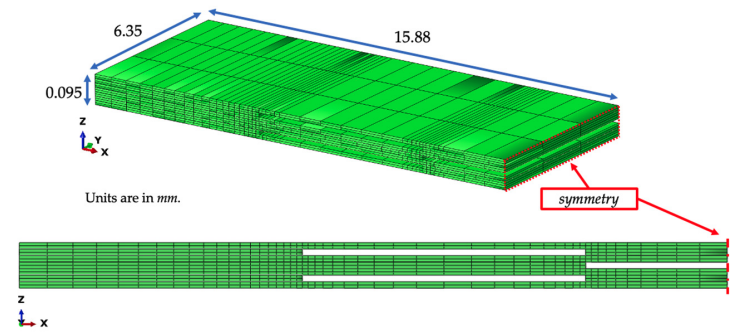
Run Abaqus/Explicit Hex8 user-element models for coupled compaction, heat, pressure, saturation, and cure.
Preserve finite resin and air ownership inside closing tow gaps while feeding cavity pressure back to adjacent plies.
Latest manuscript results
The new three-dimensional inventory-based VUEL formulation couples deforming prepreg to moving tow-gap control volumes. Three studies test directional bleed-out, finite cavity storage, pressure feedback, resin retention, air removal, and localized fiber waviness.
Predicted at the largest measured strain, versus 0.6088 experimentally.
Maximum pointwise error for longitudinal and transverse discharge.
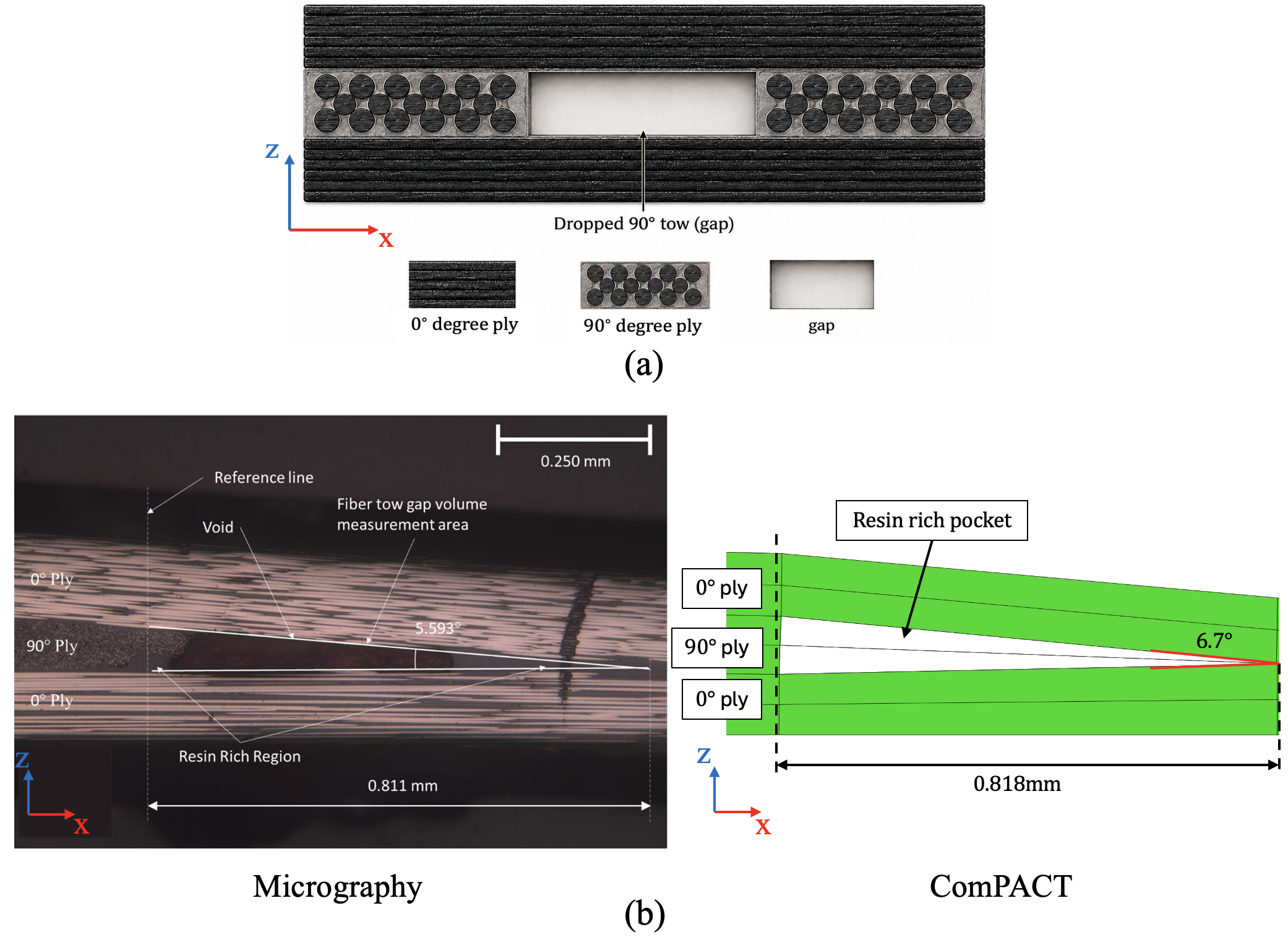
Difference between the isolated-gap prediction and published micrograph.
Maximum donor-plus-gap mass-balance error in the isolated-gap study.
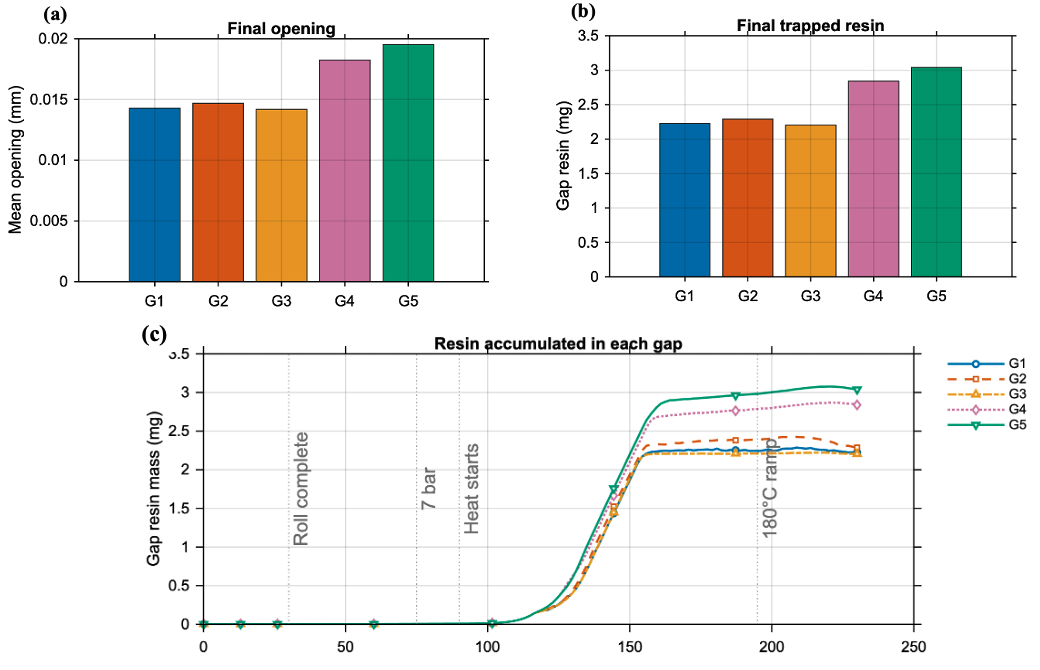
Mean opening and resin mass retained by G4-G5 relative to G1-G3.
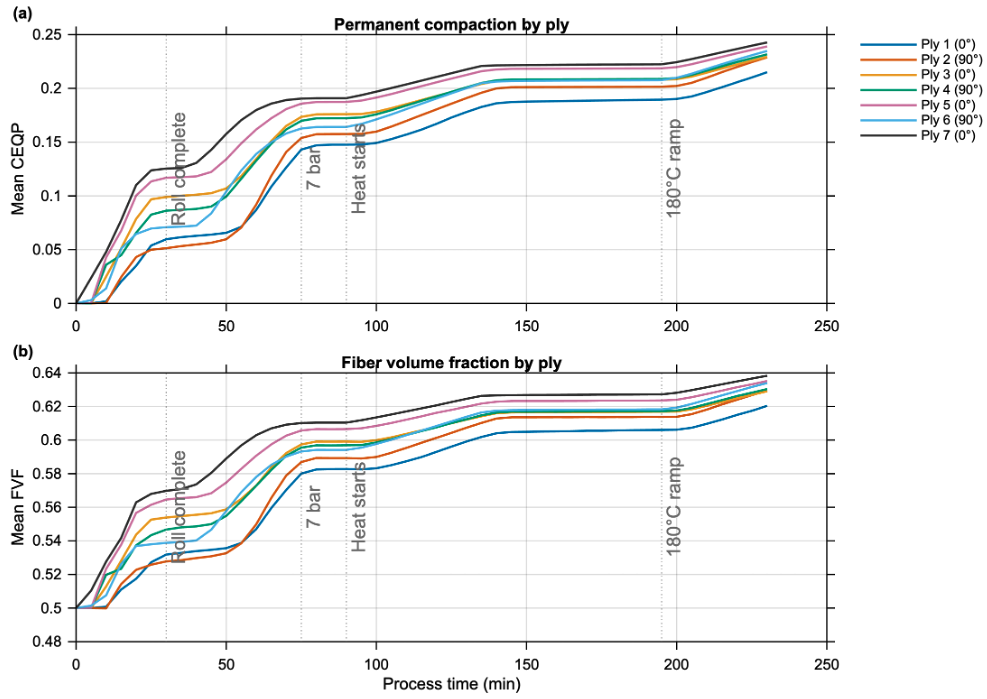
Endpoint value for the seven-ply staggered-gap laminate.
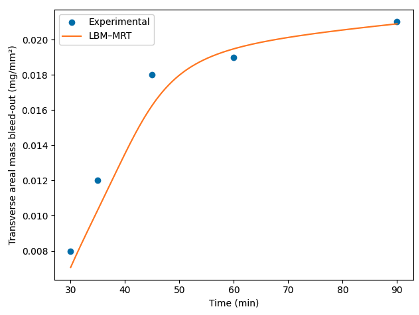
One coupled IM7/8552 calculation reproduces the nonlinear rise in fiber volume fraction and the much stronger longitudinal drainage observed over a 90-minute pressure-and-temperature history.
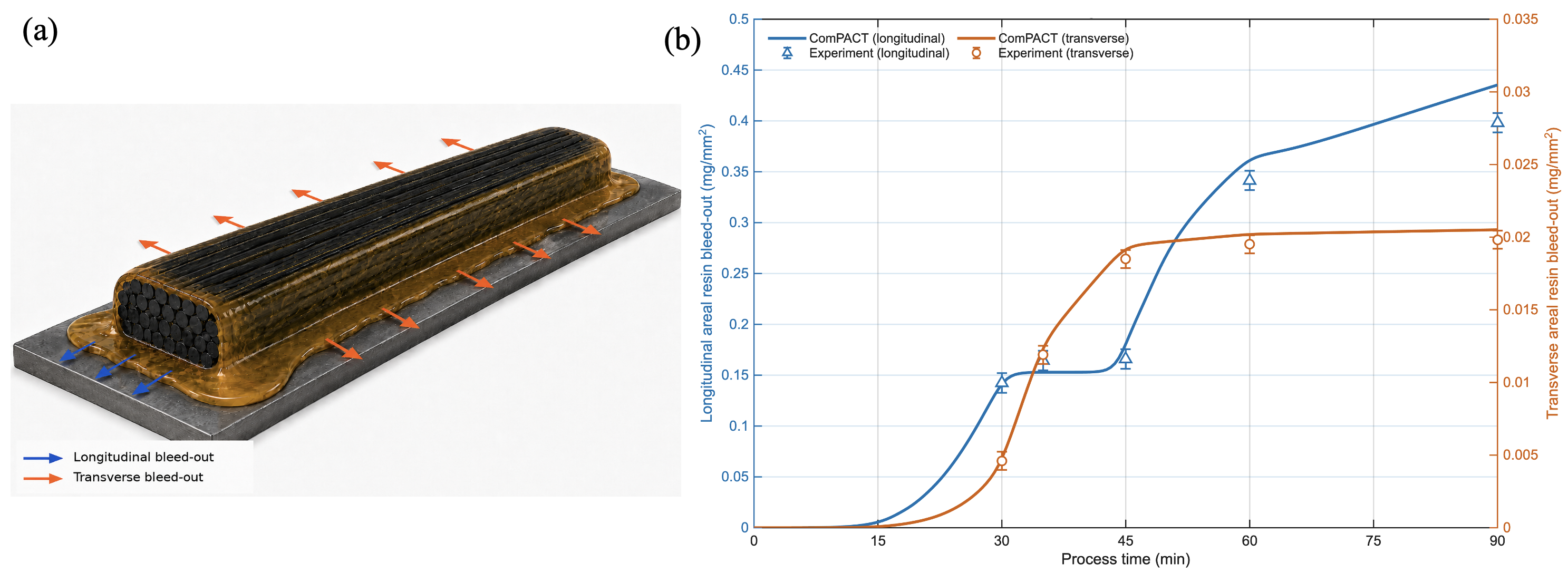
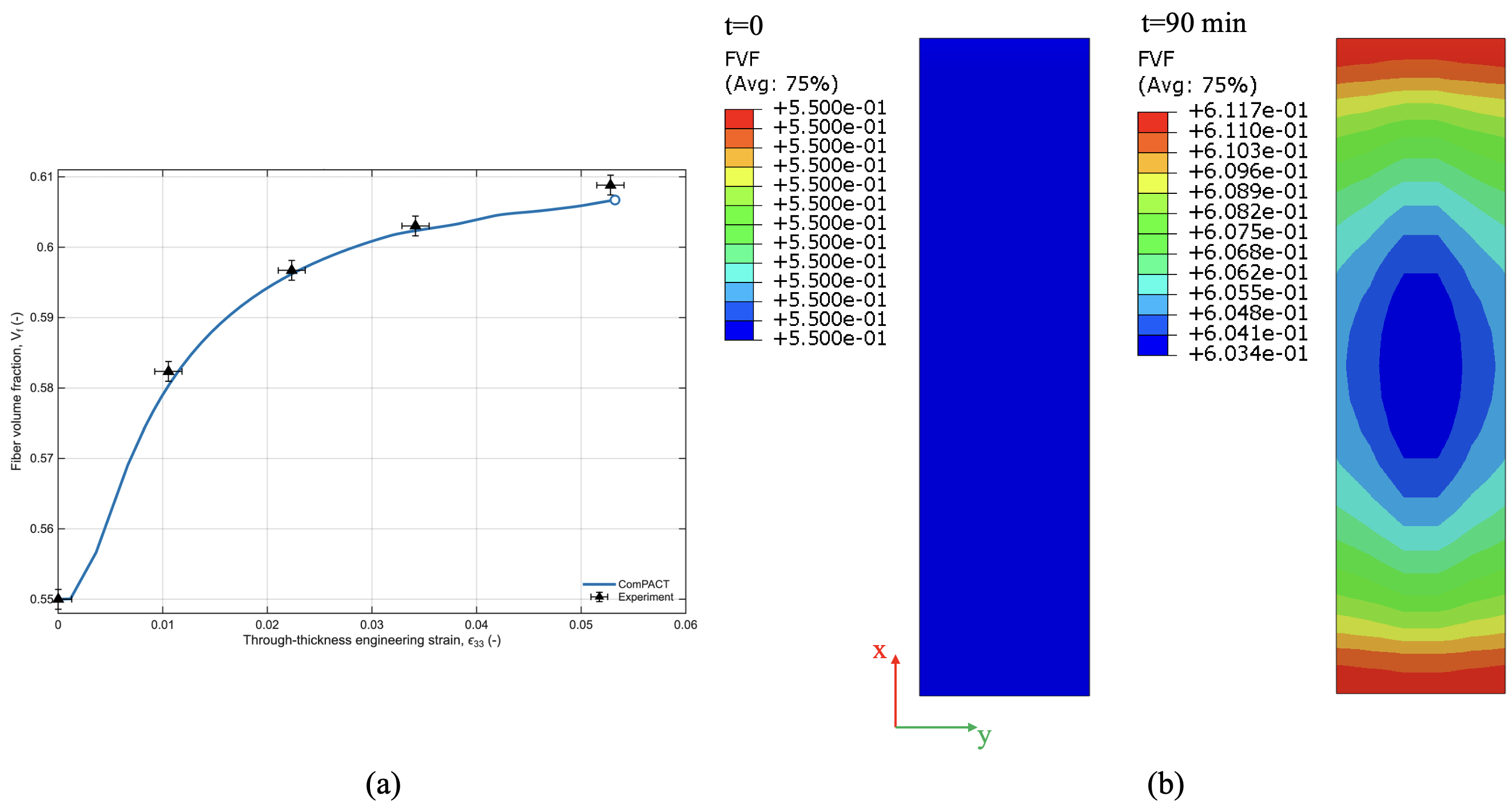
The transport parameters were selected using these measurements, so this study is a calibration benchmark rather than an independent validation.
A reduced [0/90/0] laminate isolates the two-way cavity mechanism: ply motion changes gap volume, gas compression and resin filling set cavity pressure, and that pressure loads the bounding plies.
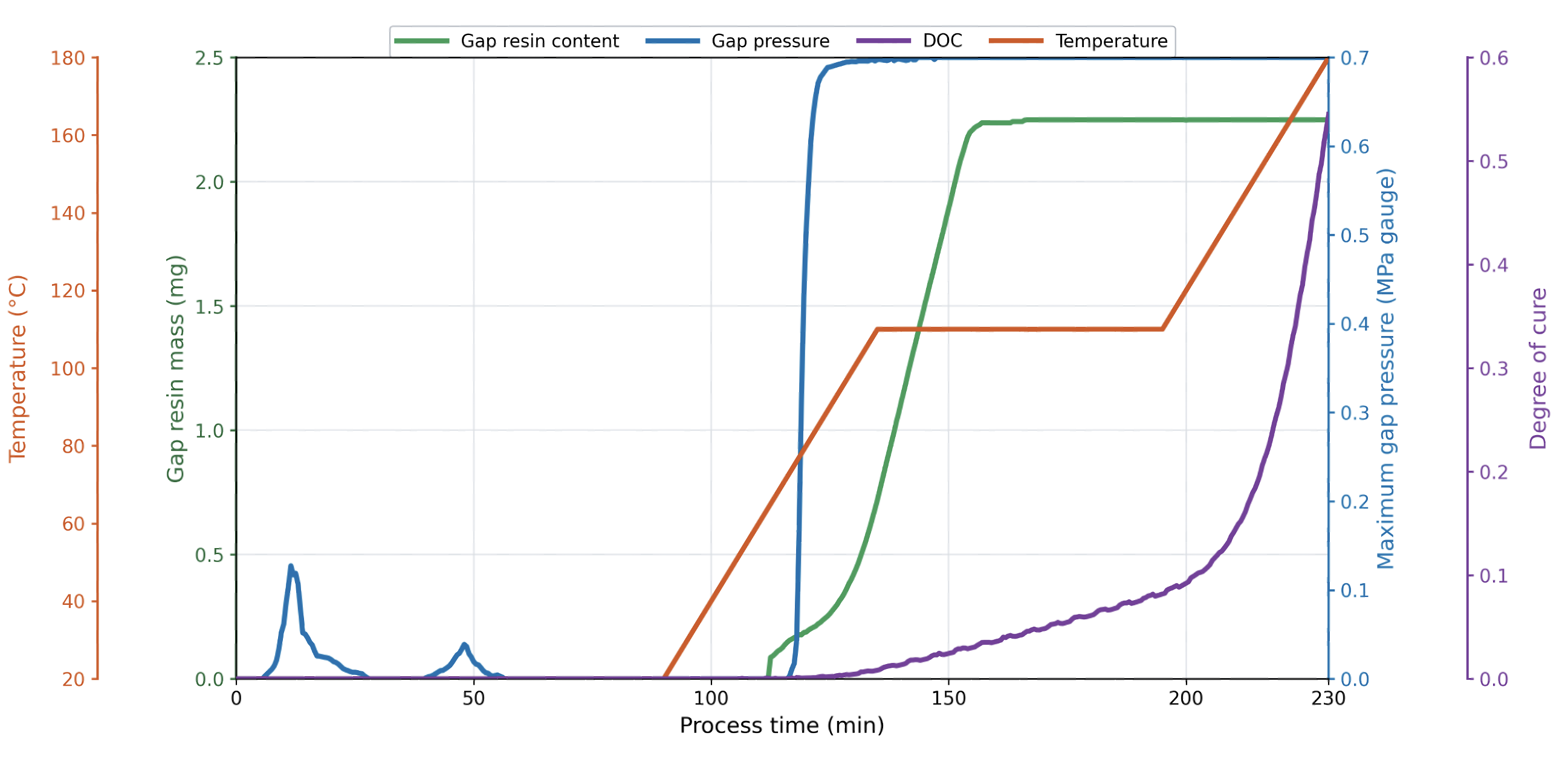
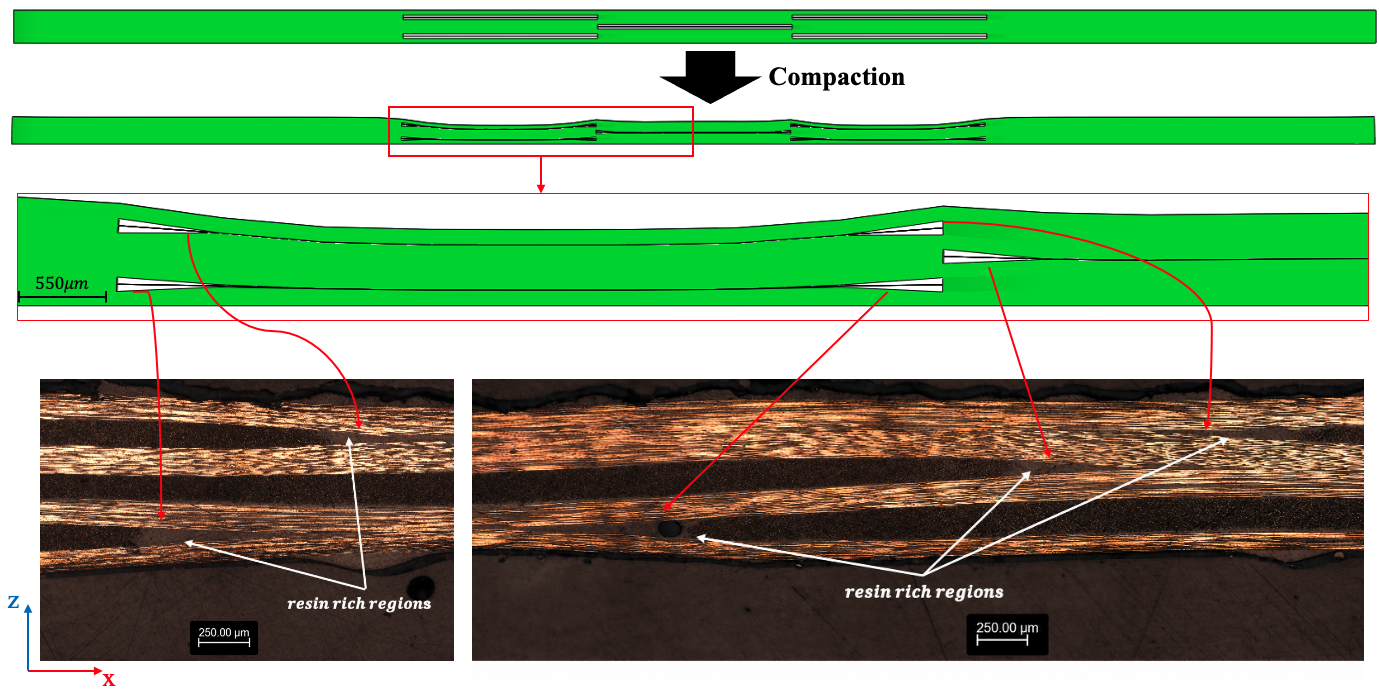
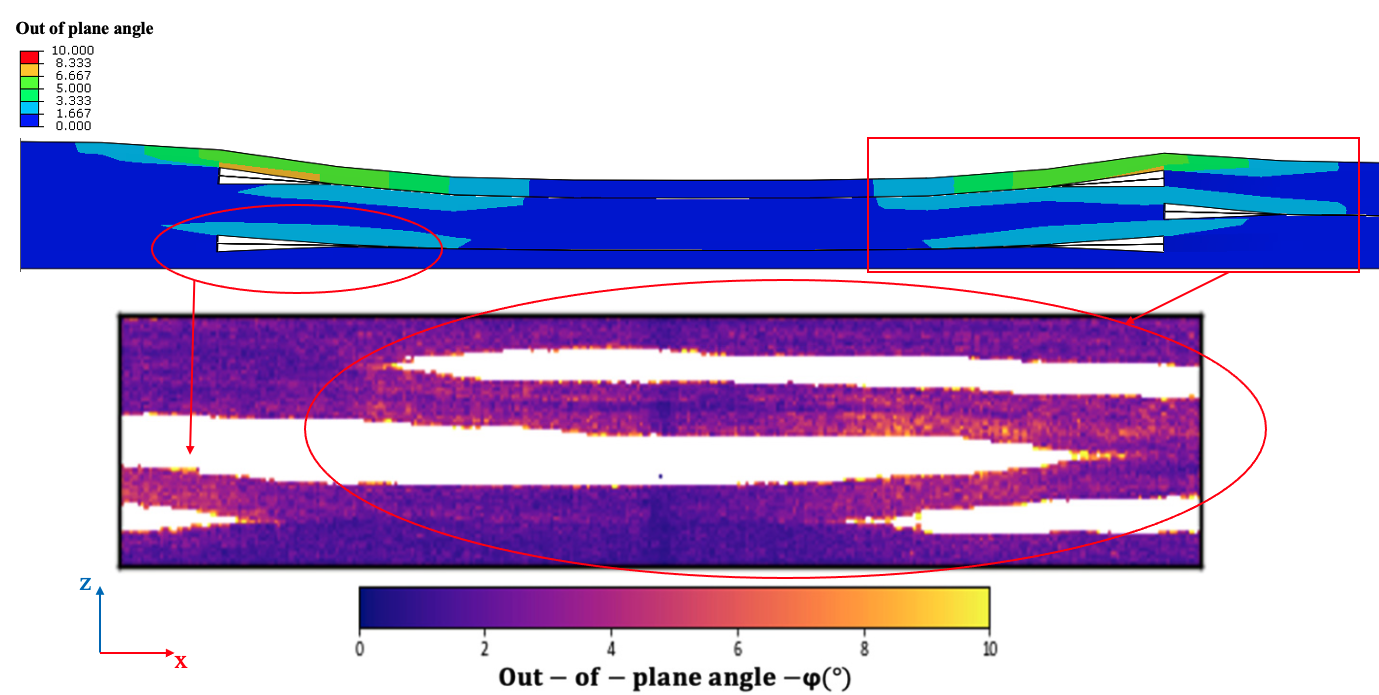
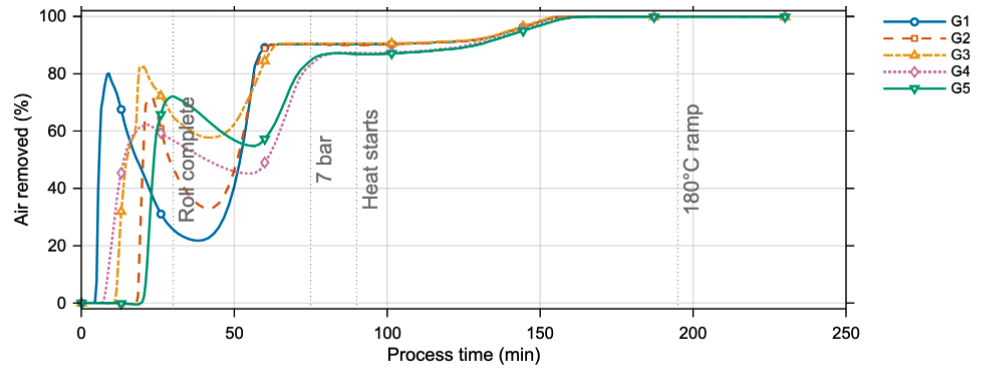
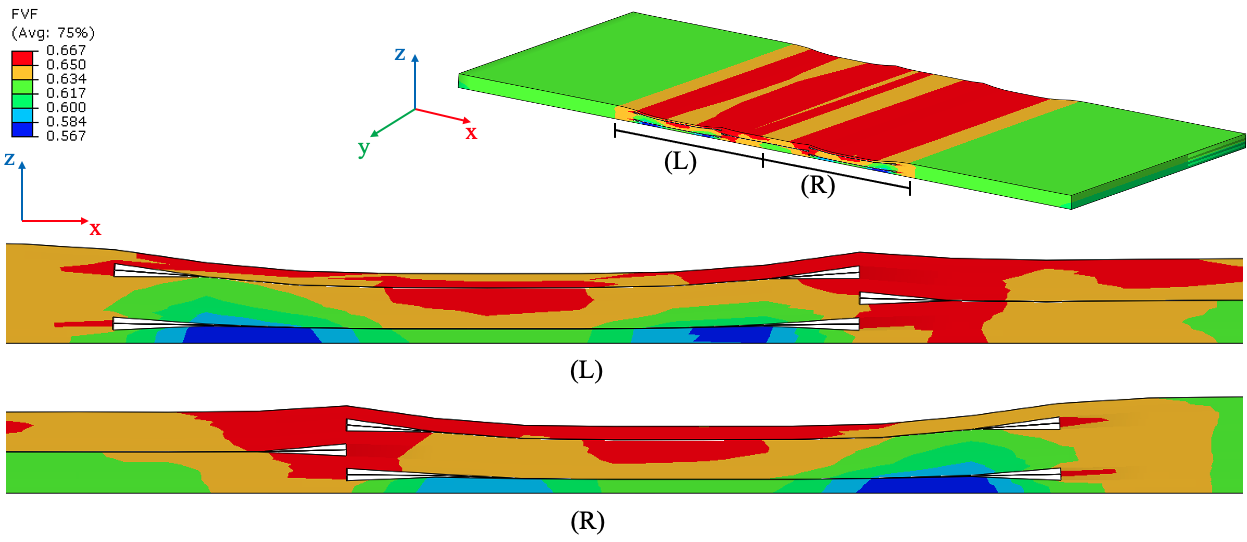
A seven-ply [0/90/0/90/0/90/0] laminate links through-thickness gap position and bridging support to residual opening, retained resin, compaction heterogeneity, and out-of-plane fiber rotation.
Additional demonstrations
These cases highlight additional manufacturing challenges, modeled physics, and outputs that can guide process design.